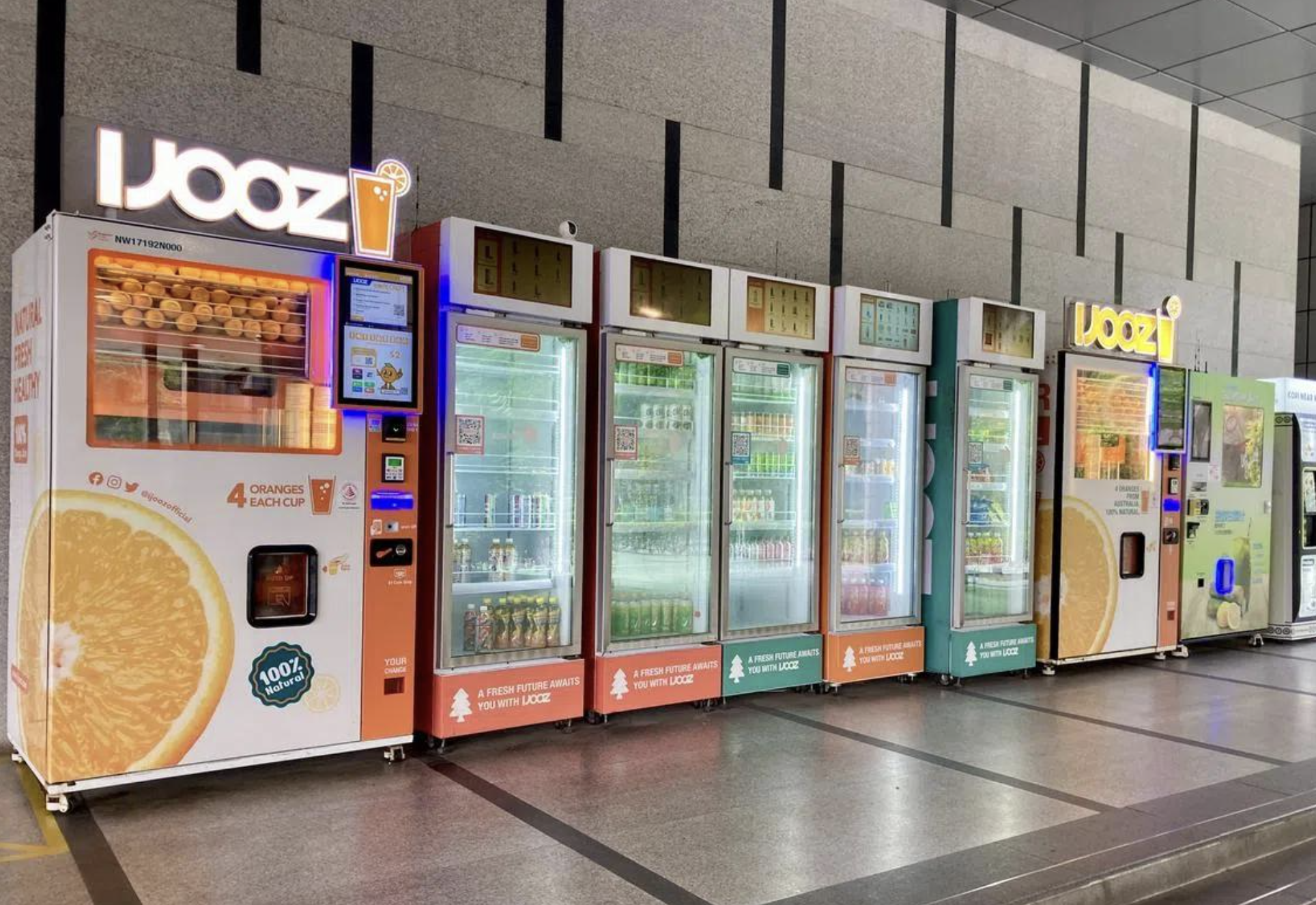
IJOOZ is one of the most visible examples of fresh orange juice vending operating at scale. Founded in Singapore, the company has built its model around automated orange juice machines supported by software, operating data and a fresh-fruit supply chain. IJOOZ currently reports more than 2,500 active vending machines, operations across 32 countries and more than 70 million cups sold. These figures are company-reported.
For entrepreneurs looking at this market, the more useful question is not simply what an IJOOZ machine does. It is how the complete business model works behind the machine.
IJOOZ Is More Than an Orange Juice Machine
For the customer, the transaction is simple: choose a drink, pay and receive freshly squeezed orange juice from an automated machine.
Behind that transaction is a much larger operating system.
IJOOZ describes its technology as a combination of robotics, machine vision, AIoT, hardware and software. Founder Bruce Zhang has described IJOOZ as a technology company, while CNA has reported that the company develops its hardware, software and data-management systems in-house to support functions such as replenishment and maintenance.
That distinction matters because a fresh orange juice vending business has to manage more than the customer-facing machine. It also needs to know how much fruit is required, when machines need refilling, where maintenance is required and how a growing network can be managed efficiently.
How the IJOOZ Business Model Works
The operating model can be understood as a connected system:
Location → Machine → Fruit Supply → Replenishment → Remote Management → Customer Sales → Operating Data
The location creates customer demand. The machine produces and sells the juice. Fresh oranges have to be sourced, stored and delivered. Machines need to be replenished, cleaned and maintained. Sales and machine data then help the operator decide what needs attention next.
IJOOZ says its cloud platform supports sales forecasting, inventory tracking, refill-route planning and dynamic scheduling. The company also reports that its Smart Juicer can serve around 180 cups before oranges need to be refilled.
CNA has described how this works operationally in Singapore: drivers receive instructions on how many oranges individual machines require and the routes they should follow, while the system can also help identify maintenance requirements.
This means the vending machine is not operating as an isolated retail unit. It is one connected point inside a larger supply and operating network.
Why Can This Model Scale?
Singapore provides the clearest example of what this model can become.
By 2025, CNA reported that IJOOZ had built a network of around 1,500 machines in Singapore. Its machines can be found across locations including MRT stations, schools, offices, shopping centres, residential areas and tourist locations.
At this scale, operational efficiency becomes increasingly important. IJOOZ reports that 10 operations staff can support more than 500 machines in Singapore. This is company-reported information, but it illustrates why software, remote monitoring and efficient replenishment become important as a vending network grows.
IJOOZ also currently reports operations across 32 countries. The exact operating and partnership model can differ between markets, but the broader lesson remains the same: the opportunity is not simply to install individual machines. It is to create a retail network that can be repeated across suitable locations.
What New Operators Can Learn From IJOOZ
The main lesson from IJOOZ is that the machine should be viewed as one component of the business rather than the entire business.
A new operator needs to think about:
Machine + Location + Supply Chain + Remote Management + Repeatable Operations
The practical sequence is therefore:
Choose the market → identify locations → plan the operating setup → select the machine → launch a pilot → measure → scale
A pilot allows the operator to learn from actual sales, fruit consumption, refill requirements and location performance before committing to a larger network.
IJOOZ demonstrates what fresh orange juice vending can look like at scale. A new operator does not need to begin at that scale, but the operating principles behind it are useful when designing a business that may eventually grow beyond the first machine.
Considering Fresh Orange Juice Vending in Your Market?
TECHX32 helps buyers evaluate the machine, operating setup and practical requirements for their first fresh orange juice vending location.